References Cited in the Collective Timeline
Adams, Robert McC. ‘Shepherds at Umma in the Third Dynasty of Ur: Interlocutors with a World beyond the Scribal Field of Ordered Vision’. Journal of the Economic and Social History of the Orient 49, no. 2 (2006): 133–69.
Ashuraya, Sapra. Layout and expansion of city over the centuries. May 6, 2016. Accessed Mar. 1, 2017: https://upload.wikimedia.org/wikipedia/commons/3/3b/AthurMdinta.jpg.

Bidmead, J. The Akitu Festival: Religious Continuity and Royal Legitimation in Mesopotamia. Gorgias Dissertations: Near Eastern Studies 2, 2002.
Briant, Pierre. From Cyrus to Alexander: A History of the Persian Empire. Winona Lake, Ind: Eisenbrauns, 2002. Pp. 13-28
Britannica Academic, s.v. "New Year festival," accessed March 15, 2017, http://academic.eb.com.ezp-prod1.hul.harvard.edu/levels/collegiate/article/New-Year-festival/55527.
Bronze band from the gates of the palace of Shalmaneser III. British Museum.
Boardman, John, Edwards, I. E. S, Hammond, N. G. L, and Sollberger, E. "Israel and Judah from Jehu until the Period of Assyrian Domination (841–c. 750 B.C.)." In The Cambridge Ancient History, 488-510. Vol. 3. Cambridge: Cambridge University Press, 1982.
Crawford, Peter. "Neo-Babylonian Empire." Digital image. Blogspot. Accessed April 19, 2017. http://1.bp.blogspot.com/-SoGo2sqPaTA/UzXDfYwaDLI/AAAAAAAACN0/-aHnm6ECwdI/s1600/neo-babylonian-empire - Jewish Exile - Chosen people of the Demiurge - Books of Foundation - Peter Crawford.jpg.
Curtis, John and Nigel Tallis. The Balawat Gates of Ashurnasirpal II. British Museum Press, 2008.
Dalley, Stephanie Mary. "Semiramis." The Oxford Classical Dictionary, 2012, The Oxford Classical Dictionary.
Dolce, Rita. “Ebla and Its Origins.” In Proceedings of the 6th International Congress of the Archaeology of the Near East, edited by Paolo Matthiae, Frances Pinnock, Lorenzo Nigro, and Niccolo Marchetti. Roma: Universita di Sapienza. 2009.
Foster, Benjamin R. The Age of Agade: inventing empire in ancient Mesopotamia. New York, NY: Routledge, 2016.
Foster, Benjamin. "A New Look at the Sumerian Temple State." Journal of the Economic and Social History of the Orient 24, no. 3 (1981): 225-41.
Frankfort, Henri. Kingship and the Gods : A Study of Ancient Near Eastern Religion as the Integration of Society and Nature. Oriental Institute Essay. Chicago, University of Chicago Press, 1948. Pp. 215-274.
Grayson, K. Assyrian and Babylonian Chronicles. Indiana: Eisenbrauns, 2000.
Grayson, K. The Early Development of Assyrian Monarchy. Ugaritica Forschungen 3: 1971. Pp. 311–319.
Great Ziggurat at Ur-Ancient Architecture. [San Francisco, California, USA]: Kanopy Streaming, 2015.
Holloway, A. “The Ancient Akitu Festival and the Humbling of the King.” Ancient Origins. Last modified September 28, 2014, http://www.ancient-origins.net/news-general-human-origins-religions/babylonian-akitu-festival-and-humbling-king-002128?nopaging=1.
Jastrow. Stele of Naram-Sin Louvre. 2005. Department of Oriental Antiquities, Louvre, Paris. Accessed Feb. 17, 2017: https://upload.wikimedia.org/wikipedia/commons/6/67/Stele_Naram_Sim_Louvre_Sb4.jpg.
Kaplan, Yehuda. “Recruitment of Foreign Soldiers into the Neo-Assyrian Army during the reign of Tiglath-pileser III.” In Treasures on Camels' Humps : Historical and Literary Studies from the Ancient Near East Presented to Israel Ephʻal, edited by Cogan et al., 135-152. Jerusalem: Hebrew University Magnes Press, 2008.
Kleiner, Fred S. and Christin J. Mamiya. Gardner's Art Through the Ages. Belmont, CA: Wadsworth/Thomson Learning, 2006.
Kramer, Samuel Noah. From the Tablets of Sumer: Twenty-Five Firsts in Man's Recorded History. Indian Hills: The Falcon's Wing Press, 1956.
Kuhrt, Amélie. ‘Cyrus the Great of Persia: Images and Realities’. In Representations of Political Power : Case Histories from Times of Change and Dissolving Order in the Ancient Near East, edited by Marlies Heinz and Marian H. Feldman, 169–91. Winona Lake, Ind: Eisenbrauns, 2007.
Laato, Antti. "Assyrian Propaganda and the Falsification of History in the Royal Inscriptions of Sennacherib." Vetus Testamentum 45, no. 2 (1995): 198-226. http://www.jstor.org/stable/1535132.
Lendering, Jona. “Astyages.” In Livius: Articles on Ancient History. 1997.
Liverani, Mario. The Ancient Near East: History, Society, and Economy. London: Routledge, 2014.
Liverani, Mario. “The Fall of the Assyrian Empire: ancient and modern interpretations.” In Empires : Perspectives from Archaeology and History. Alcock, and Alcock, Susan E. Cambridge, UK ; New York: Cambridge University Press, 2001.
Macadam, M. F. Laming. The Temples of Kawa, I & II. London: Griffith Institute/Oxford University Press. 1949 & 1955.
Machinist, P. The Fall of Assyria in Comparitive Ancient Perspective. In: Assyria 1995, Parpola, S. and R. M. Whiting (eds.). Helsinki: 1997. Pp 179-95.
Mark, Joshua J. "Assyrian Warfare," Ancient History Encyclopedia. Last modified April 18th, 2017. http://www.ancient.eu/Assyrian_Warfare/
Mark, Joshua J. "Xerxes I." Ancient History Encyclopedia. Last modified 28 April 2011. http://www.ancient.eu/Xerxes_I/.
Melville, Sarah C. 2004. "Neo-Assyrian Royal Women and Male Identity: Status as a Social Tool." Journal of the American Oriental Society 124 (1): 37-57. http://search.proquest.com.ezp-prod1.hul.harvard.edu/docview/217140432?accountid=11311.
Mitchell, Aaron. "Ashurnasirpal II Killing Lions" Relief Sculpture. Digital image. Pinterest. Accessed March 22, 2017. https://s-media-cache-ak0.pinimg.com/originals/63/8d/ea/638deac7d07bffec55a653551a9faa8c.jpg
Moorey, Roger, Jack Green, and Stephanie Dalley. "Introduction to the Ashmolean Museum collections of tablets and inscribed objects." Ashmolean - Museum of Art and Archaeology. University of Oxford. 2000. http://cdli.ucla.edu/collections/ashmolean/ashmolean_intro.html.
Nigro, Lorenzo. "The Two Steles of Sargon: Iconology and Visual Propaganda at the Beginning of Royal Akkadian Relief." Iraq 60 (1998): 85-102. doi:10.2307/4200454.
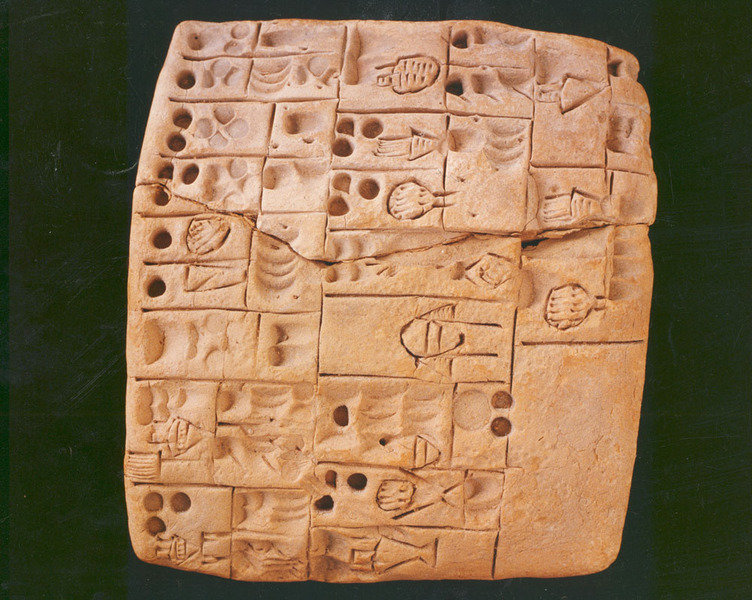
Nissen. Archaic writing tablet from Mesopotamia. 2005. Accessed Feb. 24, 2017: https://www.mpg.de/4818028/zoom-1326810479.jpg.
Noble, Duncan. "Assyrian Chariotry and Cavalry". State Archives of Assyria Bulletin 4, no. 1 (1990): 61-68
Oded, Bustenay. War, Peace, and Empire : Justifications for War in Assyrian Royal Inscriptions. Wiesbaden: Dr. Ludwig Reichert Verlag, 1992.
Orlin, Louis Lawrence. Life and Thought in the Ancient Near East. University of Michigan Press, 2007. Pp. 72-79.
Price, Ira Maurice. "The Nabopolassar Chronicle." Journal of the American Oriental Society 44 (1924): 122-29.
"Ptolemaic Empire 300 BCE." Digital image. Wikimedia. July 26, 2008. Accessed April 24, 2017. https://upload.wikimedia.org/wikipedia/commons/e/e0/Ptolemaic-Empire-300BC.png.
Postgate, J.N. The Land of Assur and the Yoke of Assur. In: World Archaeology World Archaeology 23: 1992. Pp. 247-263.
Radner, Karen. “Mannea, a forgotten kingdom of Iran.” Assyrian empire builders. University College London, 2013. http://www.ucl.ac.uk/sargon/essentials/countries/mannea/.
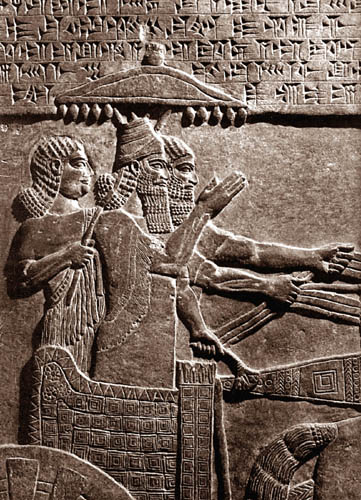
Relief of Tiglath-Pileser III. From the Neo-Assyrian period, c. 730 BCE. Image on ancientreplicas.com. Accessed Mar. 28, 2017. http://www.ancientreplicas.com/king-chariot-o.jpg
Russell, John Malcolm. "Bulls for the Palace and Order in the Empire: The Sculptural Program of Sennacherib's Court VI at Nineveh." The Art Bulletin 69, no. 4 (1987): 520-39.
Saggs, H. W. F. “Assyrian Warfare in the Sargonic Period”. Iraq 25, no. 2(1963): 145-54.
"Sennacherib." Digital image. Wikipedia. March 7, 2008. Accessed April 6, 2017. https://upload.wikimedia.org/wikipedia/commons/9/99/Sennacherib.jpg.
Smith, Clyde Curry. "The Birth of Bureaucracy." The Biblical Archaeologist 40, no. 1 (1977): 24-28.
Steinkeller, Piotr. ‘Early Political Development in Mesopotamia and the Origins of the Sargonic Empire’. In Akkad : The First World Empire : Structure, Ideology, Traditions, e
Smith, W.S. The Art and Architecture of Ancient Egypt. Harmondsworth, 1958, rev. 2/1981. pp. 395–420.
dited by Mario Liverani, 107–129. Padova: Sargon, 1993.
Strootman, Rolf. Courts and Elites in the Hellenistic Empires: The Near East After the Achaemenids, c. 330 to 30 BCE. Edinburgh: Edinburgh University Press, 2014: 1-12.
Tadmor, Hayim. “World Dominion: Expanding Horizon of the Assyrian Empire,” Landscapes: Territories, Frontiers, and Horizons in the Ancient Near East, edited by: Lucio Milano, S. de Martino, 55-62. Padova: Sargon, 1999.
Terry, Sheila. "Cuneiform Clay Tablet And Stylus." Digital image. Fine Art America. 2013. Accessed April 10, 2017. https://images.fineartamerica.com/images-medium-large/cuneiform-clay-tablet-and-stylus-sheila-terry.jpg.
Thomason, Allison Karmel. "From Sennacherib's Bronzes to Taharqa's Feet: Conceptions of the Material World at Nineveh." Iraq 66 (2004): 151-62.
Torri, Giulia. ‘Sargon, Anitta, and the Hittite Kings against Purusˇh˘anda’. Altorientalische Forschungen 36 (2009): 110-118.
Tucker, D. J. “Representations of Imgur-Enlil on the Balawat Gates.” Iraq 56 (1994): 107-16.
Van den Hout, Theo, P.J. “A review of In Search of the Indo-Europeans: Language, Archeology and Myth by J.P. Mallory.” Journal of Near Eastern Studies 55, no. 1 (1996): 57-59.
Van De Mieroop, Marc. A History of the Ancient Near East, Ca. 3000-323 BC. 2nd ed. Blackwell History of the Ancient World. Malden, MA: Blackwell Pub., 2007.
Van de Mieroop, Marc. "Assyria’s World Domination." In A History of the Ancient Near East, Ca. 3000-323 BC. Malden, MA: Blackwell Pub, 2004. Pp. 232-252.
Veenhof, Klaas. “Ancient Assur: The City, its Traders, and its Commercial Network,” Journal of the Economic and Social History of the Orient, (2010): 53, 39-82.
Veenhof, Klaas R. ‘Kanesh: An Assyrian Colony in Anatolia’. In Civilizations of the Ancient Near East, edited by Jack M. Sasson, John Baines, Gary Beckman, and Karen S. Rubinson. New York: Scribner, 1995. Pp. 859–871.
“Weld-Blundell Prism: The Sumerian King-List.” Ashmolean – Museum of Art and Archaeology. University of Oxford. http://www.ashmolean.org/ash/faqs/q001/.
Westenholz, Aage. ‘The World View of Sargonic Officials. Differences in Mentality Between Sumerians and Akkadians’. In Akkad : The First World Empire : Structure, Ideology, Traditions, edited by Mario Liverani, 157–169. Padova: Sargon, 1993.
Yoffee, Norman. ‘Political Economy in Early Mesopotamian States’. Annual Review of Anthropology 24 (1995): 281–311.
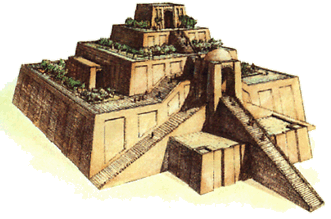
Ziggurat. Digital image. Crystal Link. N.p., n.d. Web. 8 Feb. 2017. <http://www.crystalinks.com/ziggurat1.gif>
Puhvel, Jaan. “Cuneiform,” Encyclopaedia Britannica. July 13, 2011, https://www.britannica.com/topic/cuneiform.
Kuhrt, Amélie. The Ancient Near East, C. 3000-330 BC. Routledge History of the Ancient World. London ; New York: Routledge, 1995.
Grayson, A. K. “The Early Development of the Assyrian Monarchy.” Ugaritica Forschungen 3 (1971): 311-319.
Steinkeller, Pitor. 'Early Political Development in Mesopotamia and the Origins of the Sargonic Empire'. In Akkad: The First World Empire: Structure, Ideology Traditions, edited by Mario Liverani, 107-129. Padova: Sargon, 1993.
Foster, Benjamin R. 'A New Look At the Sumerian Temple State' Journal of the Economic and Social History of the Orient 24, no. 1 (1981): 225-41.
Adams, Robert McC. 'Shepherds at Umma in the Third Dynasty of Ur: Interlocutors with a world beyond the Scribal Field of Ordered Vision'. Journal of the Economic and Social History of the Orient 49, no. 2 (2006): 133-69.
Villard, Pierre. 'Shamshi-Adad and Sons: The Rise and Fall of an Upper Mesopotamian Empire'. In Civilizations of the Ancient Near East, edited by Jack M. Sasson, John Baines, Gary Beckman, and Karen S. Rubinson. Volume II. New York: Scribner, 1995. Pp. 873-883.
Young, Gordon. Chavalas, Mark. Averbeck, Richard. "Crossing Boundaries and Linking Horizons", "Neo-Assyrian Battle Tactics", p. 501
"Adad-nirari II (reigned Ca. 911-891 B. C.)." World History. Worldhistory.biz, 13 July 2015. Web. 25 Mar. 2017.
Zamazalová, Silvie. 'Assurnasirpal II, king of Assyria (r. 883-859 BC)'. Nimrud: Materialities of Assyrian Knowledge Production. The Nimrud Project at Oracc.org. 2015. http://oracc.museum.upenn.edu/nimrud/ancientkalhu/thepeople/assurnasirpalii/.
Zamazalova, Silvie. "The Education of Neo-Assyrian Princes." In The Oxford Handbook of Cuneiform Culture, edited by Karen Radner and Eleanor Robson, 313-28. Oxford: Oxford University Press, 2011.
Mark, Joshua J. "Tiglath Pileser III." Tiglath-Pileser III. Ancient History Encyclopedia, 19 June 2014. Web. 31 Mar. 2017.
Mark, Joshua J. "Assyrian Warfare." Assyrian Warfare. Ancient History Encyclopedia, 11 Aug. 2014. Web. 10 Apr. 2017.
Smitha, Frank E. "Assyria's Demise and Judah's Independence Lost Again." Rise and Fall of the Assyrian Empire. Macrohistory and World Timeline, 2015. Web. 14 Apr. 2017.
Cristian, Radu. "Darius I." Ancient History Encyclopedia. Ancient History Encyclopedia, 10 Apr. 2017. Web. 12 Apr. 2017.
Munn-Rankin, JM. "Darius I." Encyclopædia Britannica. Encyclopædia Britannica, Inc., 30 Oct. 2009. Web. 10 Mar. 2017.